Monday, April 21, 2014

Friday, April 11, 2014
Wilson Solar Grill

The Wilson Solar Grill can not only cook your food when the sun is out during the day, but it can store that heat energy and so you can cook your food at night. How you ask? The solar grill uses a fresnel lens to heat Lithium Nitrate. (Lithium nitrate “is the lithium salt of nitric acid. It is made by reacting lithium carbonate or lithium hydroxide with nitric acid.“) ~Wikipedia
It will store the heat energy for up to 25 hours released as a convective heat at temperatures of 450 degrees F.
Barbecuing is one of the greatest pastimes for many, but it certainly isn’t one of our most environmentally friendly. Whether you prefer charcoal, wood chips or propane, grilling releases emissions and contributes to poor air quality. Up until now, solar powered grilling has required, as you might expect, the sun, which means traditional fuel-fired grills are required after sunset. But new solar technology developed by MIT professor David Wilson could bring a nighttime solar-powered grill to the market very soon; an invention also of great benefit to those in developing nations who rely on wood to cook all their food.
In the future, these could be commonly used for backyard cooking at home:
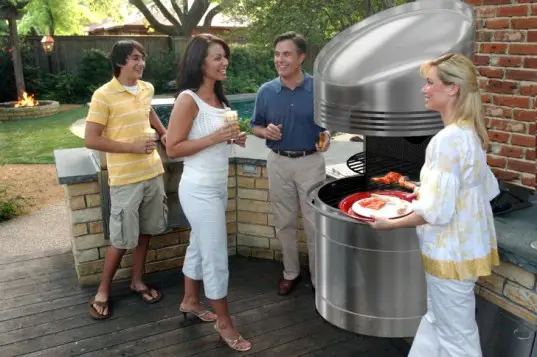
Wilson’s technology harnesses the sun and stores latent heat to allow cooking times for up to an amazing twenty five hours at temperatures above 450 degrees Fahrenheit. The technology uses a Fresnel lens to harness the sun’s energy to melt down a container of Lithium Nitrate. The Lithium Nitrate acts as a battery storing thermal energy for 25 hours at a time. The heat is then released as convection for outdoor cooking.
Friday, March 14, 2014
Waterless toilet

The toilet aims to provide an eco-friendly solution to help some of the 2.5 billion people around the world lacking safe and sustainable sanitation.
WASHINGTON: A revolutionary waterless toilet powered by the sun, developed to help some of the 2.5 billion people lacking safe and sustainable sanitation around the world, will be unveiled in India this month.
Designed and built using a $7,77,000 grant from the Bill & Melinda Gates Foundation, the self-contained, waterless toilet with its innovative technology converts human waste to biochar, a highly porous charcoal.
It aims to provide an eco-friendly solution to help some of the 2.5 billion people around the world lacking safe and sustainable sanitation.
The toilet has the capability of heating human waste to a high enough temperature to sterilise it and create biochar, a highly porous charcoal, said Karl Linden, project principal investigator and professor at the University of Colorado.
The biochar has a one-two punch in that it can be used to both increase crop yields and sequester carbon dioxide, a greenhouse gas.
The project is part of the Gates Foundation's "Reinvent the Toilet Challenge," an effort to develop a next-generation toilet that can be used to disinfect liquid and solid waste while generating useful end products, both in developing and developed nations, said Linden.
Since the 2012 grant, Linden and his team have received an additional one million dollars from the Gates Foundation for the project, which includes a team of more than a dozen faculty, research professionals and students, many working full time on the effort.
Linden's team is one of 16 around the world funded by the Gates "Reinvent the Toilet Challenge" since 2011.
All have shipped their inventions to Delhi, where they will be on display on March 20-22 for scientists, engineers and dignitaries.
"Biochar is a valuable material," said Linden. "It has good water holding capacity and it can be used in agricultural areas to hold in nutrients and bring more stability to the soils," he said.
"A soil mixture containing 10 per cent biochar can hold up to 50 per cent more water and increase the availability of plant nutrients," he said.
Additionally, the biochar can be burned as charcoal and provides energy comparable to that of commercial charcoal.
While the current toilet has been created to serve four to six people a day, a larger facility that could serve several households simultaneously is under design with the target of meeting a cost level of five cents a day per user set by the Gates Foundation.
"We are continuously looking for ways to improve efficiency and lower costs," he said.
Designed and built using a $7,77,000 grant from the Bill & Melinda Gates Foundation, the self-contained, waterless toilet with its innovative technology converts human waste to biochar, a highly porous charcoal.
It aims to provide an eco-friendly solution to help some of the 2.5 billion people around the world lacking safe and sustainable sanitation.
The toilet has the capability of heating human waste to a high enough temperature to sterilise it and create biochar, a highly porous charcoal, said Karl Linden, project principal investigator and professor at the University of Colorado.
The biochar has a one-two punch in that it can be used to both increase crop yields and sequester carbon dioxide, a greenhouse gas.
The project is part of the Gates Foundation's "Reinvent the Toilet Challenge," an effort to develop a next-generation toilet that can be used to disinfect liquid and solid waste while generating useful end products, both in developing and developed nations, said Linden.
Since the 2012 grant, Linden and his team have received an additional one million dollars from the Gates Foundation for the project, which includes a team of more than a dozen faculty, research professionals and students, many working full time on the effort.
Linden's team is one of 16 around the world funded by the Gates "Reinvent the Toilet Challenge" since 2011.
All have shipped their inventions to Delhi, where they will be on display on March 20-22 for scientists, engineers and dignitaries.
"Biochar is a valuable material," said Linden. "It has good water holding capacity and it can be used in agricultural areas to hold in nutrients and bring more stability to the soils," he said.
"A soil mixture containing 10 per cent biochar can hold up to 50 per cent more water and increase the availability of plant nutrients," he said.
Additionally, the biochar can be burned as charcoal and provides energy comparable to that of commercial charcoal.
While the current toilet has been created to serve four to six people a day, a larger facility that could serve several households simultaneously is under design with the target of meeting a cost level of five cents a day per user set by the Gates Foundation.
"We are continuously looking for ways to improve efficiency and lower costs," he said.
Saturday, March 1, 2014
More information

The existing park is 19 acre with natural resources.
There is absolutely no tender involve.
Companies or Individual who can meet my requirement gets the contract.
The park will be fully eco-friendly.
Quarter of my employees will be from the retire age group with living quarters and food provided for free.
Friday, February 28, 2014
Looking for creative people

Looking for people old (retired) and young and companies who are interested in developing an eco-friendly park.
As this is at planning stage there is no monetary returns till project takes off.
1. Bus and Van project.

2. Know-how to clean natural pond.
3. Renewable Energy.
4. Rain Harvesting and Recycle water.
5. Bamboo supply.
6. Setting up Aquaponics.
7. Security and camera system.
8. Two people with plenty of energy to spare and creative mind to assist me.
Friday, January 31, 2014
Growing vegetables underground
Growing underground! Subterranean kitchen garden created in WW2 bomb shelters to grow exotic herbs and vegetables just feet below the Northern Line
- Garden set up more than 100ft below Northern Line in south London
- Uses special LED energy bulbs and hydroponics system to grow crops
- Produce includes a range of exotic herbs, shoots, vegetables and flowers
- Crops expected to be sold to restaurants and supermarkets later this year
- Masterchef star Michel Roux Jr teamed up with entrepreneurs Richard Ballard and Steven Dring to set up garden
- Air raid shelters, near Clapham North, were opened to public in 1944
Buried more than 100ft below the ground, it is an unlikely place to grow crops.
But two entrepreneurs have set up a subterranean garden in former World War Two air raid shelters in south London.
The 2.5-acre 'farm', created by Richard Ballard and Steven Dring, sits in dark, confined tunnels under the Northern Line, near Clapham North station.
Scroll down for video

 +13
+13
Unusual setting: Entrepreneurs Richard Ballard (pictured) and Steven Dring have set up a subterranean garden in former World War Two air raid shelters in London
 +13
+13
Lighting: The 2.5-acre 'farm' uses low energy LED bulbs and a hydroponics system to grow a range of crops
 +13
+13
Historic: The bomb shelters are part of the Clapham North tunnels, which opened to the public in July 1944
 +13
+13
Historic: Equipped with bunks, medical posts, kitchens and sanitation, the tunnels were constructed to accommodate up to 8,000 people, but more than 12,000 people swarmed into the tunnels during one raid
It uses special low energy LED bulbs and an integrated hydroponics system to grow a range of micro-herbs, shoots, miniature vegetables and other delicacies.
Mr Ballard and Mr Dring have spent the past 18 months conducting trials in the tunnels - with the first produce expected to start growing in March.
The crops - sold under the brand name 'Growing Underground' - are expected to hit restaurants, supermarkets and wholesalers later this year.
They will include a range of exotic herbs and shoots, including pea shoots, rocket, red amaranth (a leafy vegetable and grain), mizuna, broccoli, garlic chives, red vein sorrel, mustard leaf, radish, coriander and Thai basil.
 +13
+13
Team: Mr Ballard (left) and Mr Dring (right) have joined forces with acclaimed chef Michel Roux Jr (centre)
 +13
+13
Harvesting produce: The enterpeneurs have spent the past 18 months conducting trials in the historic tunnels
 +13
+13
Crops: The produce is expected to be sold to restaurants, supermarkets and wholesalers later this year
 +13
+13
Packaged: It will include a range of herbs, including watercress (left), pea shoots and red amaranth (right)
Meanwhile, edible flowers and miniature vegetables will also be grown in the 'farm' - with plans to move onto heritage tomato varieties and mushrooms.
Mr Ballard and Mr Dring have joined forces with Michelin-starred chef Michel Roux Jr, who has joined the company as a director.
He will advise the pair on crop selection, product design and partnerships.
HOW DOES THE SUBTERRANEAN KITCHEN GARDEN WORK?
Plants and herbs need two things to grow - light and soil.
Underground tunnels have neither, but both can be substituted for LED lights and a hydroponic system.
LED lights provide plants with the wavelengths of light they need for photosynthesis - essential for growth.
Modern LED systems can allow plants to grow perfectly normally without the need for real sunlight.
Hydroponics technology allows plants to be grown without soil.
It works by dissolving the nutrients that a plant would normally get from soil into water.
The roots of a plant or herb can then be suspended, flooded, or even misted with the nutrient-rich solution, allowing it to grow successfully.
Mr Roux Jr, who runs the acclaimed Le Gavroche restaurant, said: 'When I first met these guys I thought they were absolutely crazy.
'But when I visited the tunnels and sampled the delicious produce they are already growing down there I was blown away. The market for this produce is huge.'
In order to successfully grow the crops, the temperature in the tunnels is kept at 16 degrees celsius, while produce is grown in specially-designed three-layered platforms.
Meanwhile, special filters are used to keep the air in the tunnels free of pests, eliminating the need for pesticides.
The underground caverns are part of the Clapham North tunnels - under Clapham North tube station - which were completed in 1942 and opened to the public in July 1944.
Equipped with bunks, medical posts, kitchens and sanitation, they were constructed to accommodate up to 8,000 people.
However, more than 12,000 people swarmed into the tunnels during a bombing raid on July 24, 1944.
Mr Ballard and Mr Dring hope the new crop 'farm' will help the country to achieve a carbon-free economy and successfully deal with the pressures of urban population growth.
The tunnels will be carbon neutral, with any energy needs coming from green suppliers - while food miles will also be kept to a minimum thanks to the central London location.

Tube: The tunnels sit more than 100ft below Clapham North tube station (pictured) in south-east London
 +13
+13
Ready to sell: Exotic herbs, such as Thai basil (above), will be among the crops grown in the air raid shelters
 +13
+13 +13
+13
Fresh: Vegetables such as broccoli (left) and red sorrel, peashoots and radish (right) will also be grown
The entrepreneurs have now started fundraising to accelerate the development of the business.
'Steve and I are thrilled to be close to getting Growing Underground under way. We've been experimenting for months,' said Mr Ballard.
'Now that we've secured the site we're kicking off a crowd-funding campaign today. We have a detailed business plan and we've already had lots of interest from private investors.
'We're confident that investors of all sizes will see a significant return on their investment.
 +13
+13
Hopeful: Mr Ballard (left) and Mr Dring (right) are fundraising to accelerate the development of the business.
'Integrating farming into the urban environment makes a huge amount of sense and we're delighted that we're going to make it a reality.'
He added that Chris Nelson, an expert horticulturalist used to growing crops in some of the harshest conditions on the planet, will be acting as the company's advisor.
'There is no 'could', 'might' or 'maybe' about our underground farm,' he said. 'We will be up and running and will be supplying produce later this year.'
Investors are invited to buy a stake in Growing Underground from £10, while £25,000 will enable them to have voting rights.
The duo are aiming to raise £1million from their crowdfunding drive and hope to employ up to 15 staff at the south London site.
Tuesday, January 28, 2014
Subscribe to:
Posts (Atom)