Friday, July 4, 2014

Car that runs on air

New Peugeot hybrid doesn't need a battery and 'is greener than its electric rivals'

  • The Peugeot 2008 Hybrid Air runs on nothing more than air
  • Current 'green' vehicles combine electric engines with traditional ones
  • The car has a conventional engine linked to hydraulic air motor and pump
  • It can provide zero-emissions air power for lower-speed driving in cities
  • The sports utility vehicle will available from 2016 for around £16,000

For decades, car makers have been searching for the perfect environmentally friendly fuel.
Now, one firm seems to have found the answer – a car that can run on nothing more than air.
The Peugeot 2008 Hybrid Air promises to be more ecologically sound than the current breed of ‘green’ vehicles that combine electric engines with traditional ones.
Scroll down for video
Under the bonnet: This diagram shows how the new hybrid car works. While the it is moving, air is pumped into a cylinder using surplus energy from the petrol engine, plus energy from the wheels and heat from the brakes
Clean driving: The Peugeot 2008 Hybrid Air has a conventional petrol engine linked to a hydraulic air motor and pump, allowing it to run on air, petrol, or a combination of the two - depending on driving conditions
Behind the wheel: A stripped-back look at the new hybrid. Motorists will be able to use zero-emissions air power for lower-speed driving. The feature is activated automatically when the car is doing under 43mph

It has a conventional petrol engine linked to a hydraulic air motor and pump. 
While the car is moving, air is pumped into a cylinder – just like a balloon being inflated – using surplus energy from the petrol engine, plus energy from the wheels and heat from the brakes.
The air is then released to drive the hydraulic motor – allowing the car to run on air, petrol, or a combination of the two.
Motorists will be able to use zero-emissions air power for lower-speed driving in cities. The feature is  activated automatically when the car is doing under 43mph.

When accelerating or climbing hills, combined or ‘hybrid’ mode is preferable as the vehicle receives power from both engines. And for long-distance cruising, traditional petrol power is best.
Current hybrids – such as the popular Toyota Prius – rely on heavy and expensive batteries that are difficult to dispose of, causing their own environmental problems. They can also go flat and leave the driver stranded. 
In contrast, the new Peugeot will need no batteries. Instead, it will replenish itself  automatically by re-using energy that is ‘lost’ when slowing down  and braking.
No battery required: This prototype shows motorists makes up the environmentally friendly car. Current hybrids rely on heavy and expensive batteries that are difficult to dispose of - but the Peugeot doesn't need one

No battery required: This prototype shows motorists makes up the environmentally friendly car. Current hybrids rely on heavy and expensive batteries that are difficult to dispose of - but the Peugeot doesn't need one
A look inside: Ray Massey takes a spin in the new hybrid, revealing what the car's interior currently looks like. The sports utility vehicle will be available from 2016 for around £16,000

The sports utility vehicle, available from 2016 for around £16,000, will be the first of a new generation of Peugeots and Citroens running – in part at least – on air. 
It currently manages around 94miles per gallon but engineers say that by 2020, future Peugeots and Citroens could average 117mpg.
Around 100 elite scientists have spent the past three years working on the air-powered car in top-secret conditions at Peugeot’s research and development centre at Velizy, just south of Paris. 
A spokesman for manufacturer PSA Peugeot-Citroen said: ‘We are not talking about weird and wacky machines. These are going to be in everyday cars.’

Wednesday, June 18, 2014

Mango Leaves for Diabetes

An interesting poster by Lifestyle Philippines. Mango leaves reduces diabetes risk. The poster has instruction saying, boil about 15 fresh mango leaves in water. Let stand overnight. Filter. Then drink.
 
mango leaves diabetics risks
 
Maybe eating green and yellow mango fruit yield the same result but there are reasons why choose leaves over the fruit.  Leaves are available all year round and almost always free unless your are living in the middle of skyscrapers and busy noisy roads.
It triggered my interest to find more literature. Here they are.
The young mango leaves can be eaten, mixed with native dishes or prepared as tea. I have never tried it yet however. Leaf juice is used for treatment of bleeding dysentery, asthma, coughs and other lung diseases. Addwith honey and use it to cure loss voiceDried tender leaves for curing diabeticsLeaf ash for burn and scar remedy. Leaves analysis showed 43% euxanthin acid, some euxanthon, hippuric acid, benzoic acid, mangiferin and mangin. source
Soak ten to fifteen tender mango leaves in glass of water and leave it overnight. Filter and drink on an empty stomach in the morning. Or, air dry the leaves, grind and take a teaspoon two times daily. source
Boil 3-4 mango leaves. Let stand overnight. Filter the next morning and drink before breakfast. This specific procedure is intended for lowering blood pressure, not controlling diabetes. source
It seem literature are pointing to young tender leaves. Based from my own observation, mango trees rarely produce new young leaves every year. Production of new young leaves can be induced by cutting off some branches.
Here are other findings of legitimate scientific studies.
Based on results obtained it was found that Mangifera indica has significant hypoglycemic activity in high dose and can be successfully combined with oral hypoglycemic agents in type-2 diabetic patients whose diabetes is not controlled by these agents.
source: Clinical Investigation of Hypoglycemic Effect of Leaves of Mangifera Indica in Type II Diabetes Mellitus. by: Akbar Waheed, G.A. Miana and  S.I. Ahmad. published: Pakistan Journal of Pharmacology, Vol.23, No.2, July 2006, pp.13-18
Mangiferin showed anti-diabetic as well as hypolipidemic potentials in type 2 diabetic model rats. Therefore,mangiferin possess beneficial effects in the management of type 2 diabetes with hyperlipidemia.
source: Studies on the anti-diabetic and hypolipidemic potentials of mangiferin (Xanthone Glucoside) in streptozotocin-induced Type 1 and Type 2 diabetic model rats. by:  B Dineshkumar, Analava Mitra, M Manjunatha. published: International Journal of Advances in Pharmaceutical Sciences 1 (2010) 75-85
Leaves extract have powerful antioxidant activities because of high phenol and flavonoid contents… which maybe responsible for diabetic complications in rat studies. Mango leaves extract increase peripheral utilization of glucose, increase hepatic and muscle glucagons’ contents, promote B cells repair and regeneration and increase c peptide level. It has antioxidant properties and protects B cells from oxidative stress. It exerts insulin like action by reducing the glycated hemoglobin levels, normalizing the microalbuminurea and modulating the lipid profile. It minimizes long term diabetic complications. Efforts are now being made to investigate mechanism of action of some of these plants using model systems.
source: Effect of Aqueous Extract Mangifera Indica Leaves, as Functional Foods. by: Reda M.Y. Morsi, N.R.EL-Tahan and Adel M.A. El-Hadad. published: Journal of Applied Sciences Research, 6(6): 712-721, 2010, © 2010, INSInet Publication
Mango added to a high-fat diet, prevented the increase in fat mass due to high-fat diet and
was similar in efficacy to two well-known drugs used in the treatment 
of metabolic  disorders, rosiglitazone and fenofibrate. Findings suggest that incorporation of mango in the diet may also lower risk factors for the development and progression of heart disease.
source: Mango Modulates Body Fat and Plasma Glucose and Lipids in Mice Fed High Fat Diet. by: Dr. Edralin A. Lucas et al.
++++++++++++++++++++++++++++++

Inline image 2

Friday, May 23, 2014

Using Bamboo for building affordable homes

Could bamboo solve Hong Kong's housing shortage? Two-storey lodgings built in disused factories designed to help re-home more than 250,000

  • City is home to 7m, but thousands have been left in inadequate housing
  • Bamboo homes include living area, kitchenette, bathroom and sleeping area
  • It takes just eight days to build 80 of the two-storey dwellings
  • The lodgings each use £650 worth of bamboo to construct

Lodgings made from bamboo in disused factories could be used to re-home more than 250,000 people living without permanent housing in Hong Kong, it has been claimed.
The small two-storey dwellings, which each use £650 worth of bamboo, include a living area, kitchenette, bathroom and sleeping quarters.
Taking just eight days to assemble 80 homes, the Transitional Micro-Housing project plan to build them in the interior of old industrial buildings.
Bamboo lodgings built in disused factories could be used to re-home more than 250,000 people living without permanent housing in Hong Kong, an architect has claimed
The small two-storey dwellings, which each use £650 worth of bamboo, include a living area, kitchenette, bathroom and sleeping quarters
It takes just eight days to build 80 of the bamboo homes
The small two-storey dwellings, which each use £650 worth of bamboo, include a living area, kitchenette, bathroom and sleeping quarters. It takes just eight days to build 80 of the bamboo homes
The city, home to more than seven million people, has an abundance of disused factory units after becoming one of the world's leading financial centres.
However, following the city's switch in its industrial focus from manufacturing to finance, thousands of people have been left in inadequate housing.
Dylan Baker-Rice, 34, and his wife Damita Yu, who are directors of Affect-t Design Studio, have now come up with the bamboo solution.
Mr Baker-Rice, an American living in Hong Kong, said: 'The houses were created in the belief that small-scale affordable housing need not be poor quality.
'Using local materials, we can meet the needs of the many without housing while costing just £650 each to construct in quick time.
'At current vacancy rates and estimated construction times, we expect enough capacity to house more than a quarter million who are currently without housing in the city.
Dylan Baker-Rice, 34, and his wife Damita Yu, who are directors of Affect-t Design Studio, came up with the bamboo solution
'Many of the buildings we propose to use are not abandoned but are simply underutilised.
'Like many cities across the globe, Hong Kong has increasingly shifted its economy to one service - financial.
'It means many industrial buildings are struggling to find tenants and reach full capacity.
'As the laws are changing, we would propose using these buildings on a floor by floor basis to house people.'
Mr Baker-Rice, an assistant professor of Architecture at the University of Hong Kong, has said bamboo's strength to weight ratio exceeds that of standard steel.
In fact, it's used throughout neighbouring China as a scaffolding material instead of steel tubing or timber.
Mr Baker-Rice, an assistant professor of Architecture at the University of Hong Kong, says bamboo's strength to weight ratio exceeds that of standard steel
Bamboo is used throughout neighbouring China as a scaffolding material instead of steel tubing or timber
Mr Baker-Rice, an assistant professor of Architecture at the University of Hong Kong, says bamboo's strength to weight ratio exceeds that of standard steel
The low cost material grows throughout south east Asia at rates of up to 2ft a day.
According to a recent survey of the globe's luxury hotspots, Hong Kong has the second most expensive homes in the world.
The cost per square foot of residential property in Hong Kong averages at £1,533, the Christie's Real Estate survey said.
London's homes were the world's most expensive at £2,786 per square foot.
The homes built so far have varied wall patterns so that some can provide more privacy while others offer more ventilation and communication.
Up to 850m of linear bamboo is used on each home, which is expected to last up to seven years or until people find new homes.
Hong Kong, home to more than seven million people, has an abundance of disused factory units after becoming one of the world's leading financial centres
Inside, there is a separate room for a flush toilet connected to a waste water line and the central water supply offers a shower and a sink.
For cooking and heating, an electronic hot plate is used as open gas flames are not ideal for such a small space constructed of bamboo.
However, as seen in the design drawings, a larger dedicated cooking space can accommodate gas burners away from the housing.
It is hoped this fosters interaction between residents and that the community should be relatively self-sufficient.
Mr Baker-Rice said: 'The individual dwellings should provide adequate privacy for all daily living tasks but foster increased communication.
'The houses were created in the belief that small-scale affordable housing need not be poor quality'
- Dylan Baker-Rice
'The design of the bamboo screening is to provide light and ventilation but also to open up and connect to other residents.
'When people see the homes, most are very happy and surprised by the use of bamboo as a building material and the amount of space for such a small structure.
'Some are struck by the reality that people live in such a small space but everyone is supportive of the effort and need to create housing.
'It is far too costly and time consuming to build new housing as a temporary measure but the issue of housing for all should be addressed and we hope to have solved it.
'We think they will be more secure than peoples' current living arrangements.
'At current vacancy rates, we expect 250-350 industrial buildings could meet the housing demands of everyone currently without permanent housing.
'We don't expect people to have to buy them individually as the government should bear the maintenance and building costs.'


Monday, April 21, 2014

Friday, April 11, 2014

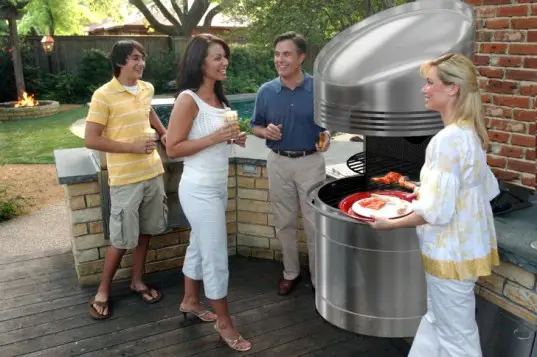
Wilson Solar Grill

http://themindunleashed.org/wp-content/uploads/2014/01/newly.jpg
The Wilson Solar Grill can not only  cook your food when the sun is out during the day, but it can store that heat energy and so you can cook your food at night. How you ask? The solar grill uses a fresnel lens to heat Lithium Nitrate. (Lithium nitrate “is the lithium salt of nitric acid. It is made by reacting lithium carbonate or lithium hydroxide with nitric acid.“) ~Wikipedia
It will store the heat energy for up to 25 hours released as a convective heat at temperatures of 450 degrees F.
Barbecuing is one of the greatest pastimes for many, but it certainly isn’t one of our most environmentally friendly. Whether you prefer charcoal, wood chips or propane, grilling releases emissions and contributes to poor air quality. Up until now, solar powered grilling has required, as you might expect, the sun, which means traditional fuel-fired grills are required after sunset. But new solar technology developed by MIT professor David Wilson could bring a nighttime solar-powered grill to the market very soon; an invention also of great benefit to those in developing nations who rely on wood to cook all their food.
In the future, these could be commonly used for backyard cooking at home:
backyardd
Wilson’s technology harnesses the sun and stores latent heat to allow cooking times for up to an amazing twenty five hours at temperatures above 450 degrees Fahrenheit. The technology uses a Fresnel lens to harness the sun’s energy to melt down a container of Lithium Nitrate. The Lithium Nitrate acts as a battery storing thermal energy for 25 hours at a time. The heat is then released as convection for outdoor cooking.

Friday, March 14, 2014

Waterless toilet

World's first solar-powered toilet set for India launch
The toilet aims to provide an eco-friendly solution to help some of the 2.5 billion people around the world lacking safe and sustainable sanitation.
WASHINGTON: A revolutionary waterless toilet powered by the sun, developed to help some of the 2.5 billion people lacking safe and sustainable sanitation around the world, will be unveiled in India this month. 

Designed and built using a $7,77,000 grant from the Bill & Melinda Gates Foundation, the self-contained, waterless toilet with its innovative technology converts human waste to biochar, a highly porous charcoal. 

It aims to provide an eco-friendly solution to help some of the 2.5 billion people around the world lacking safe and sustainable sanitation. 

The toilet has the capability of heating human waste to a high enough temperature to sterilise it and create biochar, a highly porous charcoal, said Karl Linden, project principal investigator and professor at the University of Colorado. 

The biochar has a one-two punch in that it can be used to both increase crop yields and sequester carbon dioxide, a greenhouse gas. 

The project is part of the Gates Foundation's "Reinvent the Toilet Challenge," an effort to develop a next-generation toilet that can be used to disinfect liquid and solid waste while generating useful end products, both in developing and developed nations, said Linden. 

Since the 2012 grant, Linden and his team have received an additional one million dollars from the Gates Foundation for the project, which includes a team of more than a dozen faculty, research professionals and students, many working full time on the effort. 

Linden's team is one of 16 around the world funded by the Gates "Reinvent the Toilet Challenge" since 2011. 

All have shipped their inventions to Delhi, where they will be on display on March 20-22 for scientists, engineers and dignitaries. 

"Biochar is a valuable material," said Linden. "It has good water holding capacity and it can be used in agricultural areas to hold in nutrients and bring more stability to the soils," he said. 

"A soil mixture containing 10 per cent biochar can hold up to 50 per cent more water and increase the availability of plant nutrients," he said. 

Additionally, the biochar can be burned as charcoal and provides energy comparable to that of commercial charcoal. 

While the current toilet has been created to serve four to six people a day, a larger facility that could serve several households simultaneously is under design with the target of meeting a cost level of five cents a day per user set by the Gates Foundation. 

"We are continuously looking for ways to improve efficiency and lower costs," he said.